Jorge Méndez Blake in 'Fragments of Displacement'

Jorge Méndez Blake
December 2, 2025 - March 1, 2026 | FF Projects, Miami

Curated by Omar Lopez-Chahoud, Fragments of Displacement features works by Mario Garcia Torres, Brian Eno, John Giorno, Andrea Geyer, Jose Davila, Gonzalo Lebrija, Chantal Peñalosa Fong, Stefan Bruggemann, Ian Waelder, Malibu, Linnea Goransson, Andre Komatsu, Jorge Mendez Blake, Matteo Callegari, Alessandro Moroder, Julia Rometti, Abigail Reyes, & Richie Culver.

The exhibition features site specific installations throughout the Miami Produce Distribution Center in Allapatah.

More Info

Gonzalo Lebrija & Jorge Méndez Blake: FINISTERRE at Travesia Cuatro

Jorge Méndez Blake
November 22, 2025 - February 15, 2026 | Travesia Cuatro, Madrid

Gonzalo Lebrija and Jorge Méndez Blake went to the Costa da Morte and brought back something they did not know they were looking for: lighthouses. Or rather: one imaginary lighthouse, made up of little bits of all the lighthouses—like a synthesis of all of them into one. They could have gone to Cornwall or Brittany or Cork, even to Tierra del Fuego or Nova Scotia, without bringing back the lantern of Lariño, or the sirens of Finisterre, or the light of Silleiro, and instead bringing back other lanterns, other sirens, and other light beams, and the result would have been much the same. Is what we feel when we look out onto the sea from any of the lighthouses mentioned really different from what we feel at any other lighthouse? Thinking that the answer is “yes” would turn us into mere stamp collectors. It is not the case. 

 Jorge Méndez Blake and Gonzalo Lebrija have traveled to the Costa da Morte at night precisely for that reason: daytime infatuation gone, mysteries reveal themselves in their full indecipherability. The candle that once gave light before it was snuffed out, the incandescent silhouette of a boat crossing the horizon, the luminous crown of a tower in the middle of the Atlantic, the imagined conversations between sailors and lighthouse keepers… without their cold presence, without their Beckett-like solitude, without their words—or our own—to point out what transcends us, Finisterre would not even have a name. As stated in one of the dialogues of the exhibition: lighthouses, fractions of hope, flickering over the horizon. “The fog surrounds us,” says one sailor in the same dialogue. “And our light traps us in it,” answers another. 

More Info

Jorge Méndez Blake and SUPERFLEX in 'BAZAAAR'

Jorge Méndez Blake, SUPERFLEX
September 6 - October 25, 2025 | OMR, Mexico City

Time stretches. It folds, loops and drifts. In its suspended form—beyond productivity or linearity—a different kind of logic emerges: one driven byplay, contemplation, and subtle acts of disobedience an joy.

BAZAAAR is a group exhibition that brings together artists through limited edition works that explore time as pause, as excess, as fertile drift for play and anarchy. Between the absurd and the intimate, the humorous and the delicate, these works inhabit the edges of utility and reason. They rest, they joke, they get distracted. They propose leisure not as escapism, but as a radical way of being in the world—a gentle revolt against the demand to always produce, explain, or advance towards the ever elusive idea of accomplishment. Conceived as an ephemeral and affective space of circulation,

‍BAZAAAR unfolds as a collection of gestures that invite us to inhabit the present differently: through slowness, through sensation, through wandering attention. Because in this suspended temporality—in its idleness and softness—other ways of seeing, relating, and existing quietly take shape.

More Info

Jorge Méndez Blake in BE-LONGING: An Exhibition of the Mercedes-Benz Art Collection in Mexico City

Jorge Méndez Blake
May 30 – August 31, 2025 | Espacio CDMX, Mexico City

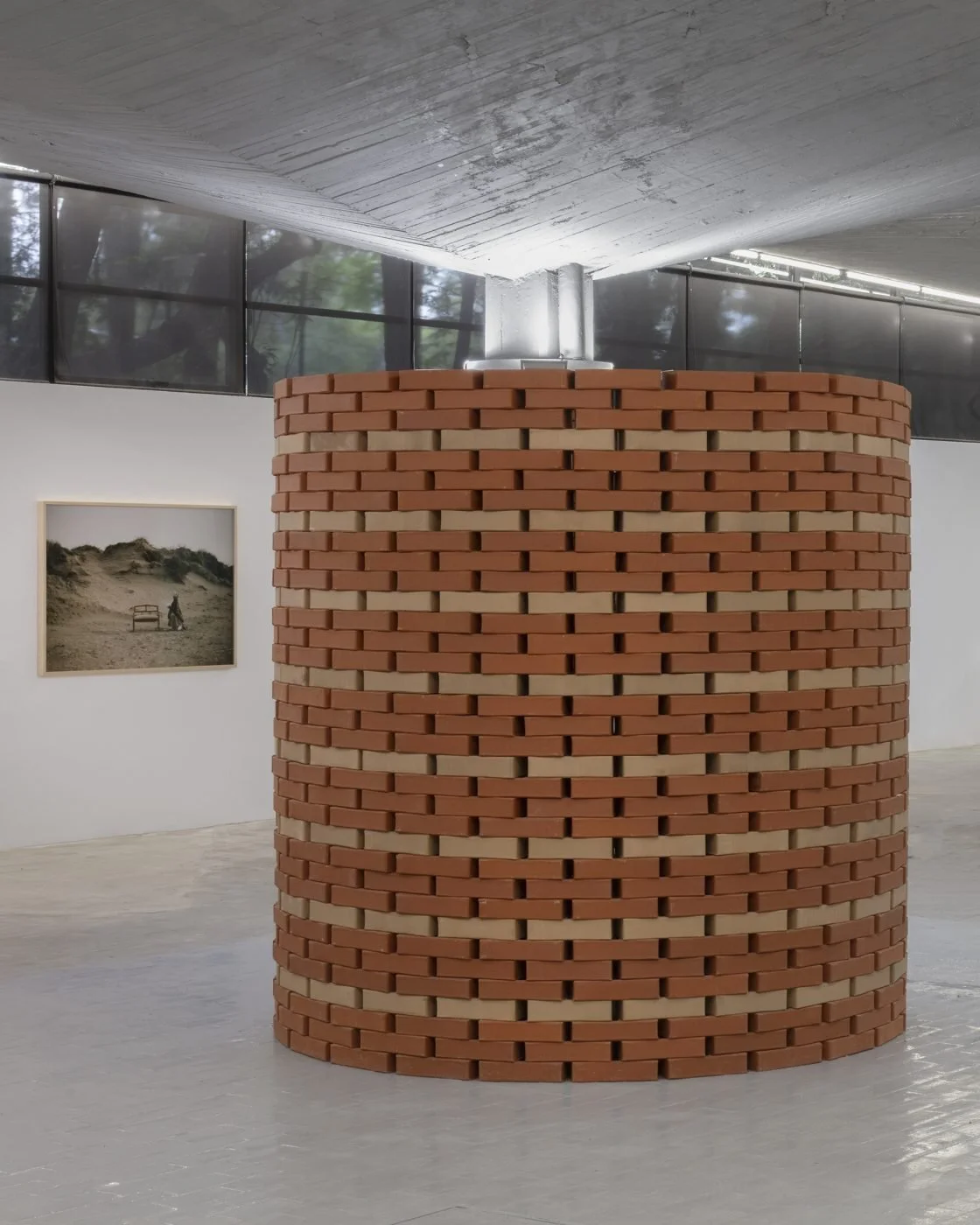
Jorge Méndez Blake, Poema en estructura circular (Stevens), bricks, ink, paper, 2025 and Buhlebezwe Siwani, Mnguni, inkjet print, 2019, Mercedes-Benz Art Collection © Courtesy the artists and for Jorge Méndez Blake: OMR, photo: Ramiro Chaves.

Curated by Polina Stroganova for the Mercedes-Benz Art Collection, BE-LONGING brings together selected works from the Mercedes-Benz Art Collection and contemporary artists living and working in Mexico. The exhibition explores the theme of identity, a subject deeply embedded in contemporary artistic discourse and continuously negotiated within society at large. The works by 32 international artists illustrate not only the relevance and complexity of the chosen topic, but also its potential to promote individual and collective resilience.

The exhibited works deal with identity-forming aspects such as bodies, origins, memories, geographies and vocations. These thematic strands allow for multiple interpretations and perspectives on identity emphasizing the concepts of fluidity, dialogue, and the interplay between different points of view. Visitors are invited to contribute their own experiences and associations to this dialogue, making a space for exchange, reflection and critical engagement with the evolving nature of identity in contemporary society. The exhibition’s scenography is designed by the esteemed Mexico City-based architectural studio C Cúbica, which has developed a modular display tailored to the concept of the exhibition. This design reinforces the exhibition’s emphasis on interconnectedness and multiplicity.

The show marks the launch of a series of dialogue-driven, international exhibitions of the Mercedes-Benz Art Collection designed to engage with local artistic practices. Through a dynamic and modular approach, this initiative aims to reach a broad international audience while fostering collaborations between Mercedes-Benz employees, different communities as well as diverse artistic networks in key international locations—Mexico City being the first.

More Info

You Stretched Diagonally Across It: Contemporary Tapestry curated by Su Wu at Dallas Contemporary

Jorge Méndez Blake
April 11 – October 12, 2025 | Dallas Contemporary

You Stretched Diagonally Across It: Contemporary Tapestry is at once a celebration of the genre and a categorical collapse, offering extended engagement with tapestry while magnifying how its contemporary practitioners are challenging the material, ideological, and narrative conventions of the age-old medium. Across works by thirty artists, the exhibition suggests tapestry as an active inflection point for unresolved inquiries into the human condition, including notions of authenticity, durational effort in the face of technological efficiency, and depictions of vastness and omniscience in physical form. The tapestries here move beyond the rigid ethnographic categorizations that have often guided the presentation of textile in institutional settings, instead reflecting circulations of people, materials, plants, and trade colors, both native and not, and identities that are temporary and contentious, or even unverifiable.

Taking its title from a letter written by Kafka, in which he imagines his father’s presence woven across a map of the world, “You Stretched Diagonally Across It” depends, like the pieces that compel it, on exceeding fixed latitudes and boundaries – between art and craft, perception and tactility, and tradition and improvisation – even to the point of unraveling. A tapestry, as posited by guest curator Su Wu, is an object in which the image and its substrate are co-arising, in a medium that often makes of gesture a devotion. In our screen-mediated contemporary moment, the exhibition offers tapestry as uniquely situated to reconsider material and temporal significance – whether it matters what our myths are made of – and the relationship between surfaces and the structures that comprise them.

More Info

At Guadalajara Art Weekend, Open Studios Are the Biggest Draw

Jorge Mendez Blake, Jorge Pardo and Pae White | Observer

Ceramica Suro’s annual Comida celebration during ART WKND GDL. Photo by Tuna Unalan.

By Elisa Carollo

The highlight of the evening at Plataforma was a conversation between Cuban artist Jorge Pardo and American artist Pae White, both of whom have long-standing ties with José Noé Suro. Pardo’s immersive, labyrinthine installation of luminous ceramic walls and colorful lamps seamlessly intertwined with White’s newest series of sculptures, forming an engaging, multisensory environment that explored how visual curiosity and emotional impulses shape perception.

The final stop was the studio of conceptual artist Jorge Méndez Blake, whose multimedia practice explores the intersection of literature, art and architecture—disciplines humans use to define their existential and operational space, imposing structure and direction upon it. Deconstructed pages of famous books transform into constellations of meaning, as Méndez Blake distills single characters, isolating them in a careful, rational order. Across his sprawling studio, various workstations held a series of hyperrealistic paintings, which, through trompe-l’œil techniques, similarly yet more directly challenge the viewer’s perception of reality. These paintings also serve as tools for conceptualizing and developing his other projects, reinforcing the artist’s fascination with language, illusion and the ways in which knowledge is both constructed and dismantled.

Read more here.

Pick of the Week: Jorge Méndez Blake

Jorge Méndez Blake | Whats On LA

By Jody Zellen

Jorge Méndez Blake is an artist based in Guadalajara, Mexico whose art takes apart and re-construct literary texts and re-present them as concrete poetry. Méndez Blake works on paper and canvas in addition to creating wall and ceiling based installations. In his exhibition I remember it was raining..., Méndez Blake uses the writings of the American poet Elizabeth Bishop (1911-1971) as a point of departure rather than universally recognized authors such as Kafka, Joyce, Borges or Dickinson. Bishop was known for her highly detailed, objective and distanced point of view with an avoidance of personal subject matter and Méndez Blake tries to turn that distance into something more personal and familiar. For example, the silkscreen print I remember it was raining (Bishop), (all works 2023) simply states, "I remember it was raining and I was reading Elizabeth Bishop."

Read More Here

Jorge Méndez Blake: Amerika

Jorge Méndez Blake | Brooklyn Rail | by Colin Edgington

1x1.jpg

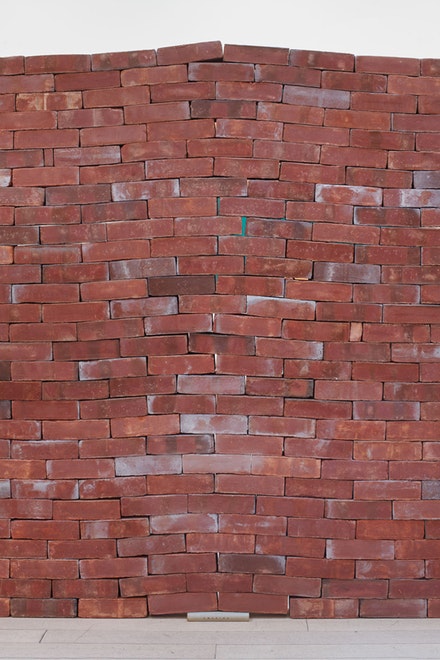
The reds of the brick wall call out to me as I enter the gallery. I want to feel the gritty texture, the red that beckons in my mind both the clay of the earth and of blood. At 33 feet long, its foreboding presence is an affront to the space, cutting through like national borders do through the landscape. The bricks range from deep maroons to warm-tinged tones, many of which are stained with white as if washed with the calcium of bones. A wall is an indifferent object that creates difference around it, impeding movement and obscuring vision. The top of the wall reaches to about my eye level and I can see the word “Imagine” from Dread Scott’s Imagine a World Without America peeking over from the other side.

Article Continues

Jorge Méndez Blake at Travesía Cuatro

Jorge Méndez Blake | Wall Street Journal International

Jorge-Mendez-Blake-Courtesy-of-Travesia-Cuatro-1.jpg

19 Oct 2018 — 23 Mar 2019 at the Travesía Cuatro in Guadalajara, Mexico

This exhibition originates from an archive image: The architect Luis Barragán eats an apple while taking a walk through the site that will later be known as the “El Pedregal” residential complex in Mexico City. The image shows an indefinite landscape made out of volcanic rock, eventually it will be covered up and delimitated with concrete walls and other construction materials. The photo shows a primeval land, a newly discovered Garden of Eden. The apple, a Western symbol of fresh beginnings (good or bad), functions as a certain poetic premonition that resonates along with the fertility of the volcanic soil.

Jorge Méndez Blake creates a timeless bridge between the modernist seedlings that Barragán planted within his volcanic garden in the 1940’s and one of his first residential projects in Guadalajara, the Casa Franco built in 1929. The artist uses the checkerboard design of the original floor of this house and reproduces it through the walls of the residence and as a departure point for other works of tautological nature.

More Information