
Uta Barth | EXIT Imagen y Cultura #99, Published March 2026
by Guillermo Espinosa
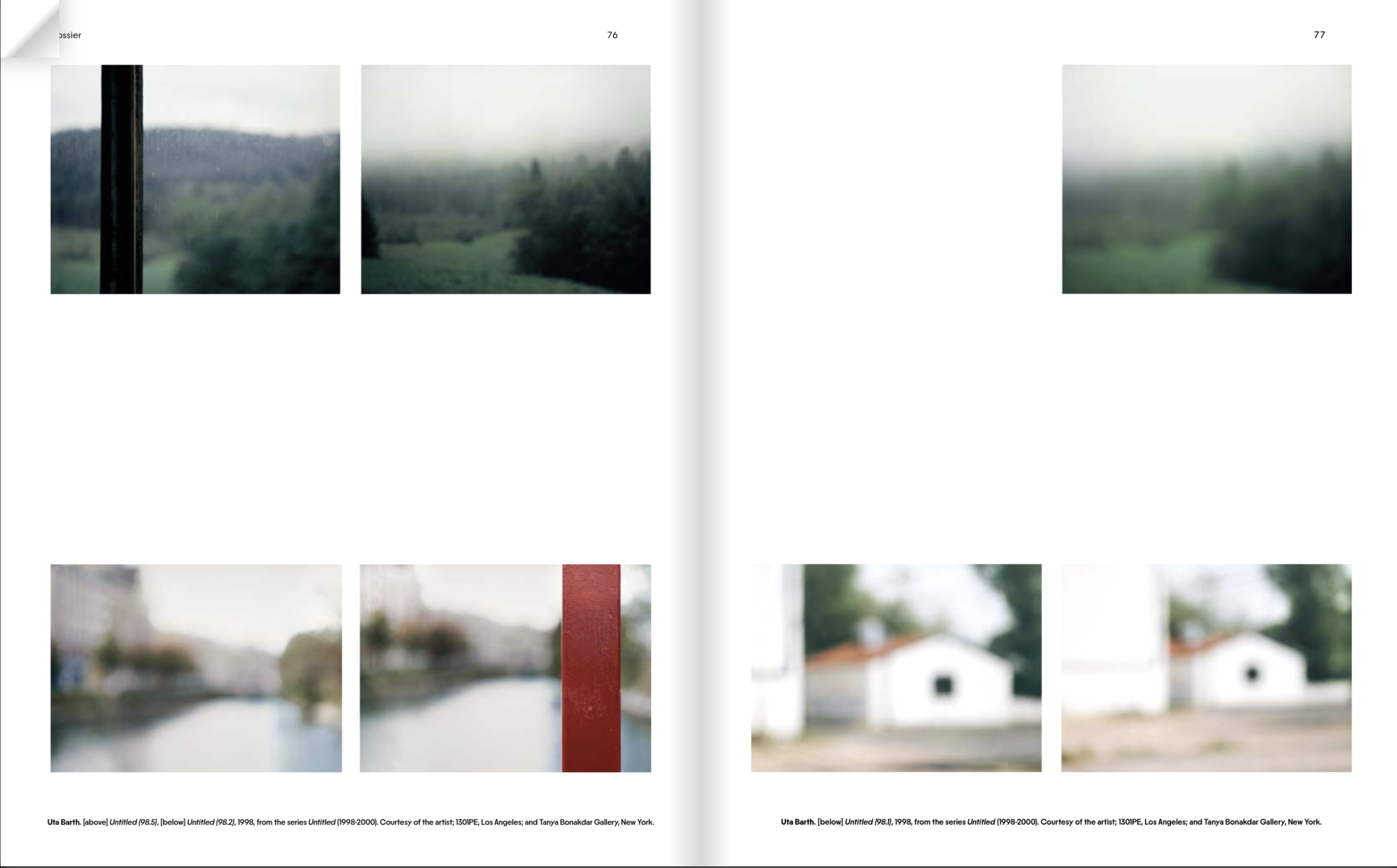
Few fine art photographers have accommodated phenomenology into their work in a more direct and enlightening way than Uta Barth (Berlin, 1958). The German-American photographer’s evident desire to redefine the act of looking in perceptual terms triggers questions that relate directly to the culture of the image and the meaning that looking imparts on the act of representation. It is a position that can possibly be traced back to her reading of two works that are central to the development of knowledge and aesthetic theory in the 20th century: Phenomenology of Perception (1945, translated into English in 1961) by the French Marxist Maurice Merleau-Ponty, and Art and Visual Perception: A Psychology of the Creative Eye (1958, revised and extended in 1974) by the German Gestalt psychologist Rudholf Arheim. The first of these works holds that is is the body—and not the conscience—that truly allows us to interpret reality and illuminate our subjective interpretation of the world through a biological mechanism shared by all human beings. The second breaks down the processes of perception and their relationship with the creation of all images aesthetics: from the differentiation between figure and background to mathematical composition strategies and the flaws and manipulations of perception required to represent a three-dimensional reality on a two-dimensional surface. In short, both works appeal to the eye and its perceptuial processes as the true source of an interpretation of reality or its replication as an image, which is then processed subjectively by the human brain and psyche. Barth’s work can largely be seen as a conscious affirmation of these hypotheses, which explain her importance to late 2-th-centiry contemporary photography.