
Simryn Gill | Art+Australia
by Amy May Stuart
Across two recent exhibitions, Stolon Press: Flat earth (Monash University Museum of Art (MUMA), Melbourne) and Live feed (1301SW, Sydney), the experimental publishing collective Stolon Press (Simryn Gill and Tom Melick) and their interdisciplinary collaborators work with what is close at hand. Discarded cardboard boxes, coffee grounds, one’s own voice, paper, vegetables, typewritten notes, and unframed photographs and prints form the material vocabulary of these two shows. There is a responsiveness too, in their way of working. This became clear in Flat earth—an exhibition put together by Stolon Press, to which they invited long-time collaborators Khaled Sabsabi and Elisa Taber—when the exhibition’s beleaguered completion significantly altered its planned form.
[…]
Instead of Stolon Press’ proposed discursive works, they contributed the ‘residual’ elements of the piece they had planned to show, Mixed business (2025)—direct prints taken from cardboard produce boxes collected in the vicinity of their Sydney studio. Placed across the floor in three of the gallery’s four spaces were ‘carpets’ of stitched-together cardboard from the flattened boxes, with each bearing the left-over ink from its use as a printmaking plate. While Mixed business did contain text, partially obscured labelling on the boxes detailing country of origin and contents, Stolon Press again move away from directly authored writing and towards minimalist abstraction. The gesture generated an ambiguity of meaning—which like Sabsabi’s Aajyna, prompts questions around demands for legibility from both viewers and institutions.
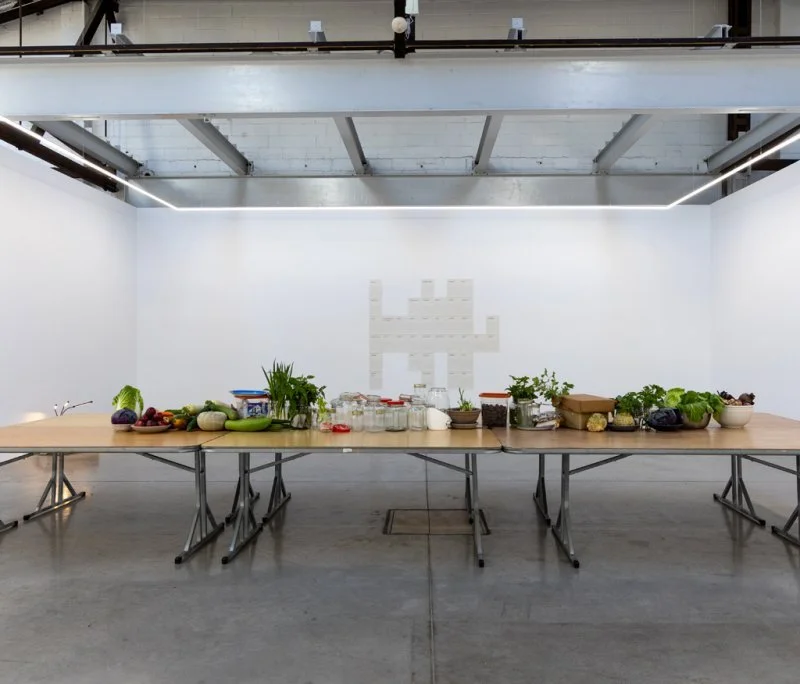
If Flat earth was characterised by minimalism and residuality, Live feed, a subsequent exhibition put together by Stolon Press, enacted an abundance of expression by the collective and their collaborator, chef Chui Lee Luk—not least through the communal dinners organised by Luk to bracket the exhibition period. Here, Stolon Press continued their long-term project of disciplinary disobedience, producing works that sat at the interstices of publishing, art and facilitating. Hosting Luk’s experiments with cooking and the fraught nature of food service they collectively asked questions of globalised flows of foodstuffs alongside the relationality of eating together.